Weight Management and the Microbiome: How Gut Bacteria Influence Your Body Composition
Dr. Chomba Chuma, MD & Founder
Founder, Velobiotics™
Discover how the trillions of microbes living in your gut act as silent architects of your metabolism, shaping your body composition in ways you never imagined. Uncover the science behind the gut-weight connection and learn how nurturing your microbiome could be the missing piece to your wellness puzzle.
If you've ever followed a strict diet, exercised consistently, and still struggled to shift stubborn weight, the answer may not lie in your willpower or your workout routine. It may lie deep within your digestive tract. The relationship between gut microbiome weight loss and overall body composition is one of the most exciting — and fastest-growing — areas of nutritional science today.
As a physician and founder of Velobiotics™, I've spent years studying how the trillions of microorganisms living in your gut influence everything from your energy levels to your fat storage, your hunger hormones to your metabolic rate. What we're uncovering is nothing short of revolutionary: your gut bacteria may be one of the most powerful levers you have when it comes to managing your weight and reshaping your body composition.
In this article, we'll explore the science behind microbiome weight management, how specific bacterial strains influence fat, muscle, and metabolism, and what practical steps you can take to harness this knowledge starting today.
What Is the Gut Microbiome and Why Does It Matter?
Your gut microbiome is a vast, complex ecosystem of bacteria, viruses, fungi, and other microorganisms residing primarily in your large intestine. Estimates suggest you carry somewhere between 38 to 100 trillion microbial cells — a number that rivals, and may exceed, the total number of human cells in your body.
These microbes are not passive passengers. They are metabolically active participants in nearly every system in your body. They help digest food, synthesise vitamins, regulate immune responses, produce neurotransmitters, and — crucially for our purposes today — directly influence how your body stores and burns fat.
The composition of your microbiome is unique to you, shaped by your genetics, birth history, diet, medication use, stress levels, sleep quality, and environment. And this unique composition has a measurable impact on your body weight.
A landmark study published in Nature demonstrated that germ-free mice (those raised without any gut bacteria) were significantly leaner than normal mice, and when colonised with bacteria from obese donors, they rapidly gained fat — even without changing their diet. This single experiment helped establish that gut bacteria metabolism is not just a side effect of weight — it is a driver of it.
The Firmicutes/Bacteroidetes Ratio: Your Microbial Weight Set-Point
One of the most researched aspects of gut microbiome weight loss is the ratio between two dominant bacterial phyla: Firmicutes and Bacteroidetes.
Research has consistently shown that:
- Obese individuals tend to have a higher proportion of Firmicutes relative to Bacteroidetes
- Lean individuals tend to show the inverse pattern
- Weight loss interventions are often associated with a shift toward a higher Bacteroidetes dominance
Why does this matter? Firmicutes bacteria are highly efficient at extracting calories from food — particularly carbohydrates. In evolutionary terms, this was an advantage during periods of famine. In the context of modern caloric abundance, however, it can mean you extract more energy from the same meal than someone with a different microbial profile.
This helps explain why two people can eat the same diet and experience very different results. It's not just metabolism in the traditional sense — it's microbial metabolism working alongside your own.
How Gut Bacteria Directly Affect Fat Storage and Muscle Building
Short-Chain Fatty Acids and Energy Regulation
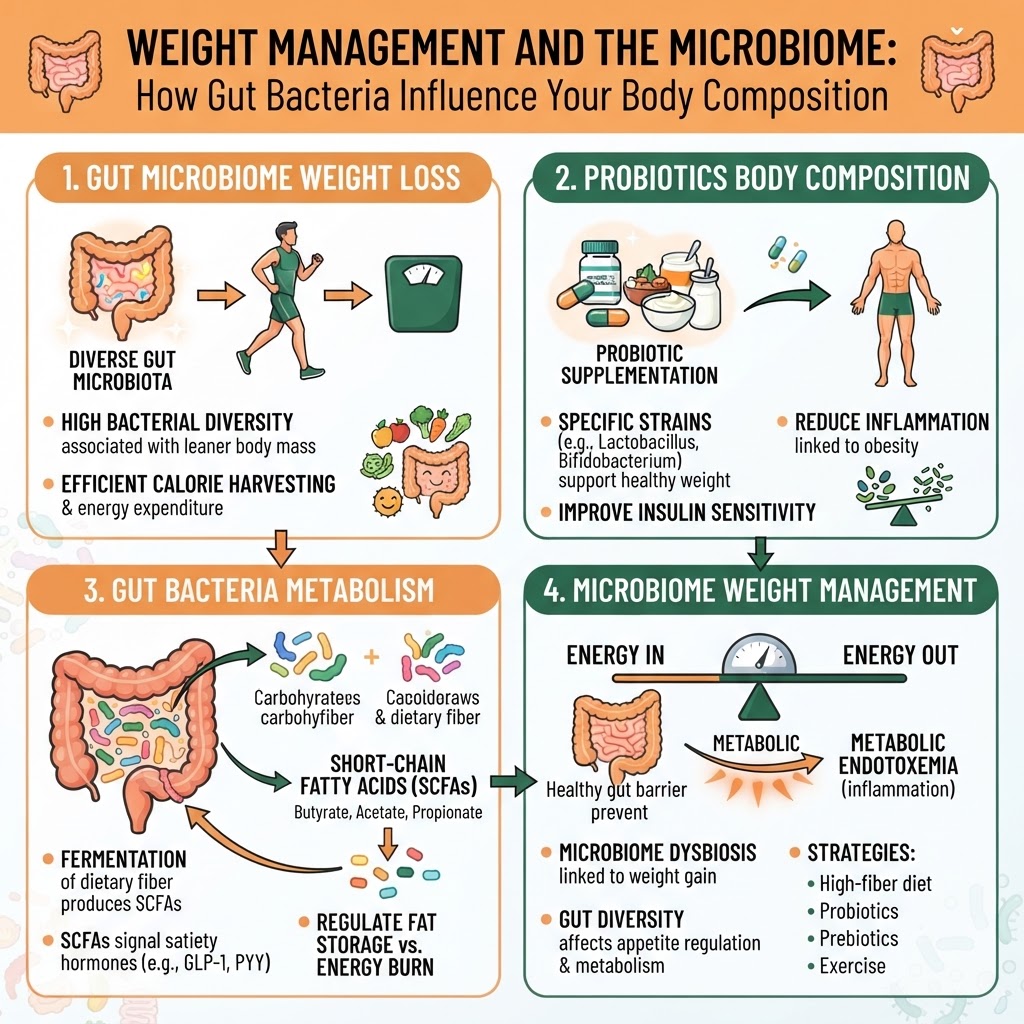
When your gut bacteria ferment dietary fibre, they produce short-chain fatty acids (SCFAs) — primarily butyrate, propionate, and acetate. These compounds have profound effects on body composition:
- Butyrate fuels colonocyte cells, reduces intestinal inflammation, and improves insulin sensitivity
- Propionate signals the liver to reduce glucose production and suppresses appetite via gut-brain hormonal pathways
- Acetate influences central appetite regulation in the hypothalamus
A diet rich in fermentable fibre supports SCFA production, which in turn supports healthy fat metabolism and reduced visceral fat accumulation.
The Gut-Brain Axis and Hunger Hormones
Your gut communicates directly with your brain through what scientists call the gut-brain axis — a bidirectional communication highway involving the vagus nerve, immune signals, and gut-produced hormones.
Gut bacteria influence the production of key appetite-regulating hormones including:
- Leptin — the "satiety hormone" that tells your brain you're full
- Ghrelin — the "hunger hormone" that stimulates appetite
- GLP-1 and PYY — incretin hormones that slow gastric emptying and reduce caloric intake
Dysbiosis (an imbalanced microbiome) can disrupt all of these signals, leaving you perpetually hungry, metabolically sluggish, and prone to overeating — regardless of how disciplined you try to be.
Inflammation, Insulin Resistance, and Fat Accumulation
An unhealthy microbiome can increase intestinal permeability — a condition sometimes called "leaky gut" — allowing bacterial endotoxins such as lipopolysaccharides (LPS) to enter the bloodstream. This triggers low-grade systemic inflammation, which is closely linked to:
- Insulin resistance
- Increased visceral fat deposition
- Reduced muscle protein synthesis
- Elevated cortisol levels
For anyone pursuing probiotic weight control or trying to build lean muscle mass, managing gut-derived inflammation is not optional — it is foundational.
Probiotics, Body Composition, and the Emerging Evidence
The use of probiotics body composition research has exploded over the last decade. While the field is still maturing, several bacterial strains have demonstrated meaningful effects in clinical trials.
Lactobacillus gasseri
Among the most studied strains for weight management, L. gasseri SBT2055 has been shown in randomised controlled trials to significantly reduce abdominal fat, BMI, waist circumference, and hip circumference compared to placebo groups over 12 weeks. The effects were lost when supplementation ceased, suggesting ongoing support is necessary.
Lactobacillus rhamnosus
A clinical trial published in the British Journal of Nutrition found that women supplementing with L. rhamnosus CGMCC1.3724 lost significantly more weight over 24 weeks than the placebo group, with continued weight loss during the maintenance phase. Men showed trends in the same direction.
Bifidobacterium longum and Bifidobacterium breve
These strains have demonstrated capacity to reduce body fat percentage, support immune regulation, and improve the metabolic markers associated with obesity, including fasting glucose and triglyceride levels.
Why Most Probiotic Supplements Fail
Here's a problem that often goes unaddressed: the majority of probiotic supplements — even high-quality ones — deliver bacteria that are largely dead or damaged by the time they reach your colon. Stomach acid, bile salts, and digestive enzymes are ruthlessly effective at destroying unprotected bacterial cells.
This is precisely the challenge that Velobiotics™ technology was developed to solve. BioGain™, our microencapsulated probiotic meal replacement, uses a proprietary encapsulation process that ensures up to 1000x more live bacteria survive transit to reach the gut where they're actually needed. If you're investing in probiotic supplementation for body composition support, delivery technology is not a minor detail — it's the difference between results and expensive urine.
You can learn more about the science behind our microencapsulation technology and why it sets a new standard in probiotic bioavailability.
Practical Strategies for Microbiome-Supported Weight Management
Understanding the science is one thing. Applying it is another. Here are evidence-informed, actionable strategies to optimise your microbiome weight management starting this week.
1. Diversify Your Dietary Fibre
The single most powerful intervention for microbiome diversity is a diverse, fibre-rich diet. Aim for:
- 30 different plant foods per week (vegetables, fruits, legumes, wholegrains, nuts, seeds)
- A minimum of 25–35g of dietary fibre daily
- Inclusion of prebiotic-rich foods: garlic, onion, leeks, asparagus, Jerusalem artichokes, green bananas, oats
Different bacteria thrive on different fibres. Diversity of intake creates diversity of microbiome — and diversity is consistently associated with metabolic health.
2. Incorporate Fermented Foods Daily
Fermented foods introduce live microorganisms and support microbial richness. Regular consumption of the following has been shown in a 2021 Stanford study published in Cell to increase microbiome diversity and reduce inflammatory markers:
- Plain, live-culture yoghurt
- Kefir
- Sauerkraut and kimchi
- Miso and tempeh
- Kombucha (lower sugar varieties)
3. Minimise Ultra-Processed Foods and Artificial Sweeteners
Ultra-processed foods are devastating to microbiome diversity. They are low in fibre, high in additives, emulsifiers, and preservatives — many of which directly harm beneficial bacterial populations. Similarly, certain artificial sweeteners, including saccharin and sucralose, have been shown to alter gut microbiota composition and impair glucose tolerance.
4. Prioritise Sleep and Stress Management
This is underappreciated but critical. Chronic sleep deprivation and elevated cortisol directly disrupt the microbiome. Poor sleep is associated with reduced Bacteroidetes and increased Firmicutes — precisely the unfavourable shift linked to weight gain. Aim for 7–9 hours of quality sleep and incorporate daily stress reduction practices such as breathwork, meditation, or walking in nature.
5. Exercise Regularly — But Recover Properly
Physical activity independently increases microbial diversity and promotes the growth of butyrate-producing bacteria. However, overtraining without adequate recovery can increase intestinal permeability and trigger the very inflammation you're trying to avoid.
If you're in a recovery phase — whether post-surgery, post-injury, or simply managing overtraining — our free Recovery App can help you track daily wellness metrics, nutrition, and gut health markers to ensure you're rebuilding optimally rather than digging yourself deeper.
6. Consider a Targeted Probiotic Supplement
Not all probiotic supplementation is equal, as discussed above. For those specifically targeting body composition — whether weight loss or lean muscle gain — a clinically supported, high-survival probiotic is worth considering as part of a broader strategy.
BioGain™ was formulated with body composition goals in mind. As a microencapsulated probiotic meal replacement, it combines targeted bacterial strains with a balanced macronutrient profile, making it practical for use as a post-workout recovery shake, a meal replacement, or a daily gut-health foundation. It's not a magic pill — but as part of the strategies outlined here, it offers a meaningful evidence-based contribution.
Gut Health and Muscle Building: The Often-Overlooked Connection
Most probiotic weight control conversations focus on fat loss. But gut health is equally important for those looking to build lean muscle — and this is a connection I'm particularly passionate about as the creator of the Bulk-Up Plan.
Your gut is responsible for absorbing the amino acids, vitamins, and minerals that fuel muscle protein synthesis. A compromised gut lining means reduced nutrient absorption — even if you're eating a high-protein diet, you may not be utilising those nutrients effectively.
Furthermore, gut-derived inflammation suppresses anabolic signalling. Elevated LPS and inflammatory cytokines directly inhibit the mTOR pathway — the primary driver of muscle growth. Addressing gut health is therefore not just a weight loss strategy; it's a performance and physique strategy.
The NIH has published extensive research supporting the role of the gut microbiome in modulating skeletal muscle mass and function — a field now being called the gut-muscle axis.
Our 30-day AI-powered Bulk-Up Plan integrates gut-health nutrition principles with progressive muscle gain programming, recognising that the two cannot — and should not — be separated.
Common Myths About Gut Health and Weight Loss
Let's briefly address some misconceptions that circulate widely:
- "Probiotics alone will make you lose weight." False. Probiotics are one tool among many. Without dietary and lifestyle foundations, they have limited impact.
- "All probiotics are the same." False. Strain specificity matters enormously. L. gasseri has different effects to L. acidophilus. Delivery method matters equally.
- "Gut health only matters if you have digestive symptoms." False. You can have significant dysbiosis with no obvious digestive complaints — yet still experience weight gain, brain fog, poor immunity, and hormonal disruption.
- "More probiotics always means better." Not necessarily. The quality of strains, diversity, and — critically — how many survive to the gut matters more than the headline colony-forming unit (CFU) count on the label.
Conclusion: Your Gut Is the Gateway to Your Goals
The science is unambiguous: your gut microbiome is a powerful, modifiable influence on your body weight, fat distribution, metabolic health, and muscle-building capacity. Gut bacteria metabolism is not a fringe concept — it is mainstream, peer-reviewed, and clinically actionable.
Managing your microbiome is not about following the latest trend. It's about understanding that the body is a system, and that lasting body composition change requires addressing its foundations — including the 100 trillion microbial partners you carry with you every day.
Whether your goal is sustainable fat loss, improved metabolic health, or building lean muscle, the path runs directly through your gut.
Ready to take action?
If you want to experience the difference that clinically designed, high-survival probiotic support can make to your body composition journey, I invite you to explore BioGain™ — formulated with Velobiotics™ microencapsulation technology to deliver what other supplements simply cannot.
Already in a recovery phase or managing post-surgical health? Download our free Recovery App today and start tracking the metrics that matter most to your healing and wellness journey.
Your microbiome is waiting to work for you. Give it the support it deserves.
Dr. Chomba Chuma, MD is the founder of BioGain™ and Velobiotics™, and a specialist in nutritional medicine, gut health, and sports recovery science.
Get gut-smart, one email at a time
Science made simple, practical tips and member-only offers from BioGain. No spam, unsubscribe anytime.
By subscribing you agree to receive emails from BioGain (Velobiotics). Unsubscribe in one click.
Dr. Chomba Chuma, MD & Founder
Dr. Chomba Chuma is a medical doctor and the founder of Velobiotics™ and BioGain™. With a passion for gut health, recovery medicine and evidence-based nutrition, he created BioGain™ to bring clinically effective probiotic science to people who need it most — those healing, rebuilding, and performing at their peak.
Ready to Start Your Journey?
BioGain™ delivers 1000x more live probiotics to your gut with Velobiotics™ microencapsulation technology.