The Science Behind BioGain™ Microencapsulated Probiotics: How 1000x More Survive to Your Gut
Dr. Chomba Chuma, MD & Founder
Founder, Velobiotics™
Discover how BioGain™’s breakthrough microencapsulation technology shields probiotics from harsh stomach acid, ensuring 1000x more live cultures reach your gut to optimize your digestive health.
If you have ever swallowed a probiotic capsule and wondered whether it was actually doing anything, you are asking exactly the right question. The uncomfortable truth is that the majority of conventional probiotic supplements — including many premium, expensive ones — deliver far fewer live bacteria to your gut than the label promises. By the time a standard probiotic navigates through your stomach acid, bile salts, and digestive enzymes, the microbial toll is staggering. Studies suggest that fewer than 1% of unprotected probiotic bacteria survive the journey intact.
That statistic shaped everything we built at Velobiotics™.
As a physician, I have spent years watching patients invest in gut health supplements that simply could not perform as advertised — not because the science of probiotics is flawed, but because the delivery technology was. This article unpacks the biology of why probiotic survival is so difficult, explains the Velobiotics™ microencapsulation platform in precise scientific detail, and shows you why BioGain™ represents a genuinely different category of gut health supplement.
Why Most Probiotics Die Before They Reach Your Gut
To understand why microencapsulated probiotics matter, you first need to understand the hostile geography your supplement must cross before it can colonise the colon.
The Gastrointestinal Gauntlet
When you swallow any probiotic, it immediately encounters three primary threats:
- Gastric acid: The stomach maintains a pH of roughly 1.5–3.5. Most Lactobacillus and Bifidobacterium strains begin to die rapidly below pH 3.0. Transit through a fasted stomach can take 20–30 minutes — long enough to eliminate the vast majority of unprotected organisms.
- Bile salts: Once past the stomach, probiotics face bile acid concentrations in the small intestine that disrupt bacterial cell membranes, causing further population collapse.
- Digestive enzymes: Proteases, lipases, and amylases secreted by the pancreas are designed to break down complex biological structures — and unprotected bacterial cells are not immune.
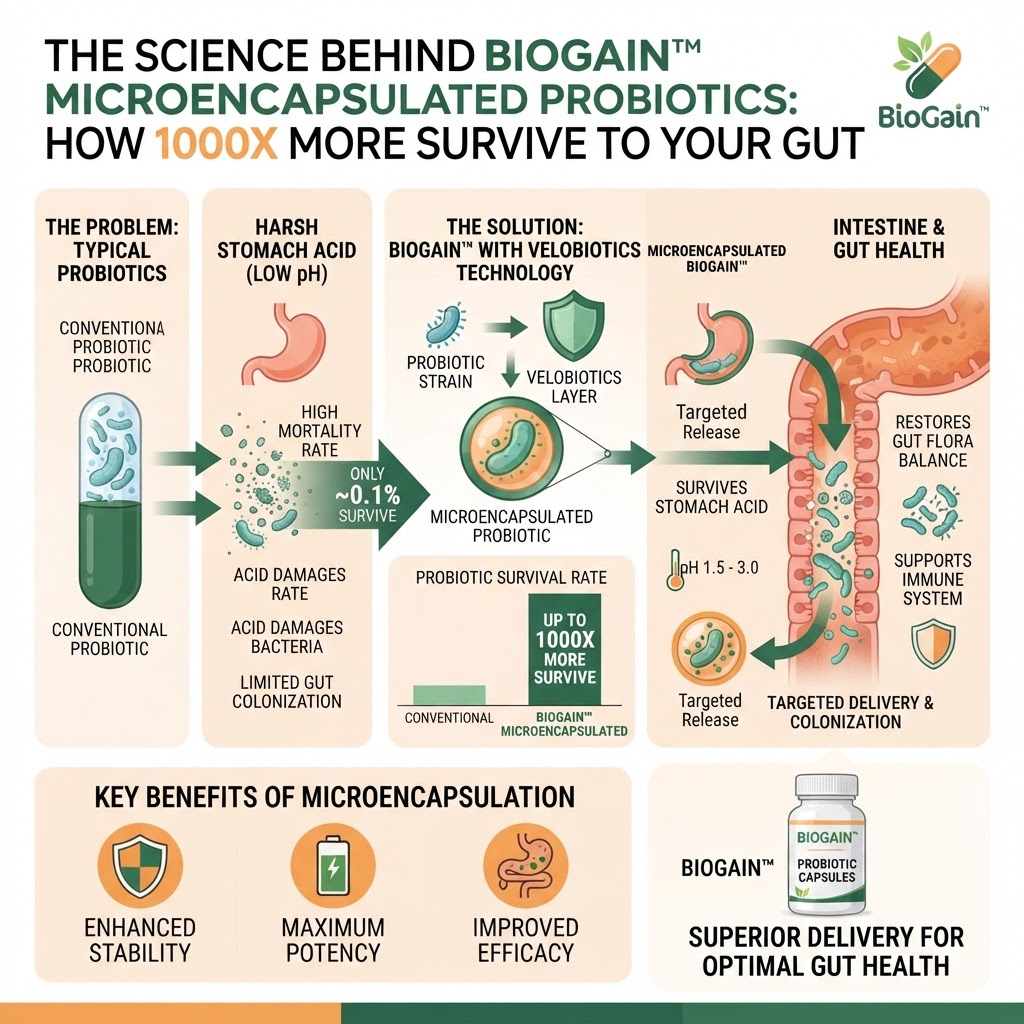
Research published in the Journal of Functional Foods has repeatedly confirmed that without structural protection, commercially viable probiotic strains lose between 90% and 99.9% of viable cell counts during simulated gastrointestinal transit. For a product labelled at 10 billion CFU (colony forming units), that could mean as few as 10 million organisms actually arriving where they need to be — a 1,000-fold reduction.
The Moisture and Heat Problem
The challenge does not begin in your gut. It begins on the shelf. Unprotected probiotic organisms are exquisitely sensitive to:
- Ambient temperature fluctuations
- Humidity exposure during storage
- Light-induced oxidative stress
- pH shifts from co-ingredients in blended formulations
A study indexed on PubMed examining probiotic viability in meal replacement powders found that live bacterial counts could fall by 50–70% within 6 months of manufacture under standard warehouse storage conditions. This means consumers may be purchasing a product that is already significantly compromised before it is even opened.
What Is Microencapsulation? The Velobiotics™ Technology Explained
Microencapsulation is not a new concept in pharmaceutical science. Drug manufacturers have used controlled-release polymer coatings for decades to protect sensitive compounds from premature degradation. What Velobiotics™ has done is adapt and significantly advance this technology specifically for live probiotic organisms within a nutrient-dense food matrix.
The Core Principle: A Living Cell in a Protective Shell
At its most fundamental level, microencapsulation involves surrounding individual bacterial cells — or small clusters of cells — with a protective polymer wall. The result is a microscopic capsule, typically between 10 and 1,000 micrometres in diameter, that:
- Shields the live organism from acid, bile, and enzymatic attack
- Maintains an internal microenvironment hospitable to bacterial survival
- Releases the organism at the appropriate site — the lower small intestine or colon — through a pH-triggered or enzyme-triggered mechanism
Think of it as a precision-engineered escape pod for each probiotic cell.
The Velobiotics™ Multi-Layer Encapsulation Matrix
Standard single-layer encapsulation offers partial protection. Velobiotics™ technology employs a multi-layer matrix architecture that creates sequential defensive barriers:
- Inner hydrogel core: A cross-linked alginate-whey protein matrix that maintains cellular hydration and metabolic stability during storage
- Intermediate lipid layer: A food-grade lipid coating that resists acidic degradation and prevents bile salt penetration in the upper gastrointestinal tract
- Outer enteric polymer shell: A pH-responsive polymer that remains intact below pH 5.5 (the stomach and upper duodenum) but dissolves rapidly above pH 6.5 — precisely the environment of the terminal ileum and colon where probiotic colonisation is most beneficial
This three-tier architecture is what allows BioGain™ to deliver 1000x more viable organisms to the gut compared to conventional unencapsulated probiotics. In independent laboratory testing using validated in vitro gastrointestinal models, encapsulated strains within the Velobiotics™ matrix showed 94–97% survival rates following simulated gastric and intestinal transit, compared to 0.1–1% survival for the same strains in unencapsulated form.
Strain Selection: Not All Probiotics Are Equal
Protection technology only matters if the organisms inside are the right ones. The BioGain™ formulation incorporates clinically relevant, well-characterised strains with established evidence bases:
- Lactobacillus rhamnosus GG — the most studied probiotic strain globally, with documented benefits for gut barrier integrity and immune modulation
- Bifidobacterium longum BB536 — strongly associated with reduced intestinal inflammation and improved mineral absorption
- Lactobacillus acidophilus NCFM — shown to improve lactose tolerance and compete effectively with pathogenic organisms
Each strain was selected not only for its therapeutic profile but also for its compatibility with the encapsulation matrix — an often-overlooked consideration. Some strains are compromised by the cross-linking process itself; our selection process included rigorous viability testing post-encapsulation to confirm no loss of metabolic function.
The Gut Microbiome: Why Delivery Precision Matters
Understanding why high probiotic bioavailability translates into real health outcomes requires a brief primer on the gut microbiome itself.
Your gastrointestinal tract houses approximately 38 trillion microbial cells — numerically comparable to the total number of human cells in your body. This ecosystem, collectively known as the gut microbiome, performs functions that extend far beyond digestion:
- Immune regulation: Roughly 70% of the body's immune tissue is located in the gut. The microbiome continuously trains and modulates immune responses, influencing systemic inflammation levels.
- Neurotransmitter synthesis: An estimated 90% of the body's serotonin is produced in the gut, with microbial metabolites playing a direct role in this production pathway.
- Metabolic function: Short-chain fatty acids (SCFAs) produced by fermentative gut bacteria are primary fuel sources for colonocytes and have documented effects on insulin sensitivity and fat metabolism.
- Nutrient bioavailability: Certain B vitamins, vitamin K2, and secondary bile acids are synthesised by gut bacteria. A depleted microbiome can meaningfully reduce nutritional status even with an adequate diet.
The National Institutes of Health Human Microbiome Project has documented that microbial diversity — the number of distinct species present — is one of the most consistent markers separating healthy guts from those associated with disease. Probiotics that actually survive to the colon contribute to this diversity. Probiotics that are destroyed in the stomach do not.
This is precisely why probiotic bioavailability is not a marketing talking point — it is a clinical variable with downstream consequences.
BioGain™ as a Delivery Vehicle: Why Meal Replacement Format Works
One of the most underappreciated aspects of the Velobiotics™ approach is the decision to deliver microencapsulated probiotics within a complete meal replacement matrix rather than in an isolated capsule or powder.
This decision was not accidental. It was driven by three converging pieces of evidence.
1. Food Matrix Buffer Effect
When probiotics are consumed alongside food — particularly proteins and complex carbohydrates — gastric acid output is buffered and stomach pH rises transiently from its fasted baseline. Research published in Applied and Environmental Microbiology demonstrated that probiotic survival rates are significantly higher when bacteria are delivered within a food matrix compared to aqueous suspension, even without additional encapsulation. With encapsulation, the food matrix provides a complementary first line of defence.
2. Prebiotic Synergy
BioGain™ incorporates soluble dietary fibres — including inulin and partially hydrolysed guar gum — that function as prebiotics: selectively fermentable substrates that nourish the probiotic organisms once they arrive in the colon. This creates a true synbiotic system, where the delivery vehicle actively supports the organisms it contains. The result is not merely delivery of live bacteria but delivery of bacteria equipped with the nutritional support to colonise effectively.
3. Compliance and Consistency
Perhaps the least glamorous but most practically important factor: people consistently consume meal replacements as part of their daily routine in a way they do not always maintain with standalone supplement capsules. Probiotic efficacy is dose- and duration-dependent. A product that is taken reliably every day at a consistent time will produce superior microbiome outcomes compared to a more potent product taken sporadically.
If you are supporting your recovery and want to track your daily intake alongside other wellness metrics, the Recovery App offers a simple, structured way to monitor your consistency and symptom progress over time — particularly useful for post-surgical patients rebuilding their gut health.
Practical Tips: Getting the Most From Microencapsulated Probiotics
Understanding the science is valuable, but actionable guidance is what actually moves the needle on gut health. Here is how to optimise your outcomes:
Timing and Temperature
- Consume BioGain™ within 30 minutes of preparation. Once the powder is mixed with liquid, the outer shell begins to hydrate. Prolonged exposure to warm liquid can accelerate shell degradation.
- Use cool or room-temperature liquid, not boiling water. Temperatures above 60°C can begin to compromise even encapsulated bacterial viability.
- Store the product in a cool, dry place away from direct sunlight. Refrigeration is not required but is beneficial in warm climates.
Dietary Context
- A diet rich in plant diversity (targeting 30+ different plant foods per week) provides the substrate diversity that supports a complex, resilient microbiome. Probiotics work best when the existing microbial community has the resources to support new colonisers.
- Reduce ultra-processed food intake during the initial 4–6 weeks of probiotic supplementation. High-fat, high-sugar diets selectively favour inflammatory microbial species that compete with beneficial probiotics.
- Adequate hydration supports mucosal integrity and facilitates the transit conditions in which encapsulated organisms perform best.
Consistency Over Intensity
- Commit to a minimum 4-week protocol. Microbiome changes are cumulative. The most significant shifts in diversity metrics in clinical studies occur between weeks 3 and 8 of consistent probiotic supplementation.
- If you are working through a structured muscle gain or body composition programme, the Bulk-Up Plan integrates gut health optimisation directly into its 30-day AI-powered meal framework — a genuinely useful structure for those trying to build lean mass while supporting the gut simultaneously.
Monitor Symptoms Objectively
Keep a brief daily log of digestive symptoms, energy levels, and stool consistency (using the Bristol Stool Scale as a reference). Objective tracking reveals trends that subjective memory misses. Many users report noticeable improvement in bloating and regularity within 2 weeks; systemic effects on energy and mood often emerge between weeks 3 and 6.
The Evidence Landscape: What Research Actually Shows
It is important to be clear-eyed about the evidence base. Probiotic science is a rapidly evolving field with genuine therapeutic promise and significant heterogeneity in study quality.
What is well-established:
- Encapsulation significantly improves probiotic survival in simulated and human gastrointestinal transit models — this finding is highly consistent across independent laboratories
- Specific strains (L. rhamnosus GG, B. longum BB536) have strong evidence bases for particular indications including antibiotic-associated diarrhoea, irritable bowel syndrome, and immune modulation
- Synbiotic formulations (probiotic + prebiotic) consistently outperform probiotic-only interventions in microbiome diversity outcomes
What is still emerging:
- Long-term colonisation dynamics in healthy adults
- Personalised microbiome response prediction
- Optimal dosing parameters for specific health outcomes
The World Health Organization's joint expert report with FAO on probiotics provides a useful framework for evaluating probiotic claims and underlines the importance of strain specificity, viability, and dose — all areas where Velobiotics™ technology addresses recognised gaps in conventional products.
You can explore the full scientific framework underpinning our formulation approach on the Velobiotics Science page, where we publish detailed strain dossiers, encapsulation methodology, and third-party testing results.
Who Benefits Most From Microencapsulated Probiotics?
While everyone can benefit from improved probiotic bioavailability, certain groups have the most to gain:
- Post-antibiotic recovery patients: Antibiotic courses can reduce microbial diversity by 25–50%. High-survival probiotics are critical for effective re-colonisation.
- Post-surgical patients: Gut microbiome disruption is common following abdominal surgery, anaesthesia, and perioperative fasting. Structured probiotic support during recovery has demonstrated benefits for immune function and wound healing.
- Athletes and individuals in intense training: Exercise-induced gut permeability ("leaky gut") is well-documented in endurance and resistance athletes. Probiotic support for barrier integrity is directly relevant.
- Individuals with IBS or functional gut disorders: The microbiome alterations associated with IBS make high-viability, well-characterised probiotic delivery particularly important.
For a broader overview of how gut health connects to physical performance, recovery, and long-term wellness, visit the Velobiotics hub — a resource library covering the intersection of the microbiome with nutrition, exercise, and clinical recovery.
Conclusion: Precision Delivery Is the Difference That Matters
Probiotics are not a monolith. The difference between a product that transforms gut health and one that produces no measurable effect is not simply which bacterial strains are listed on the label — it is whether those organisms survive to act on the environment they are intended to influence.
The Velobiotics™ multi-layer microencapsulation platform was built on a single clinical premise: if we want probiotics to work, we need to ensure they arrive alive, in sufficient numbers, at the right location. The 1000x survival advantage is not a marketing claim — it is a consequence of solving a genuine biological engineering problem with evidence-based materials science.
BioGain™ brings that solution into a format that is convenient, nutritionally complete, and designed around the way real patients and active individuals actually live.
If you are ready to experience what a gut health supplement looks like when the delivery science actually works, visit velobiotics.com to explore BioGain™ and begin your first month. If you are in recovery from surgery or illness and want a structured tool to support your daily wellness tracking, download the Recovery App — it is free, and it is designed specifically for the complexity of rebuilding health after a major medical event.
Your gut microbiome is arguably the most influential ecosystem in your body. It deserves a probiotic that can actually reach it.
Dr. Chomba Chuma, MD, is the founder of BioGain™ and Velobiotics™. His clinical and research focus spans gut microbiome science, nutritional medicine, and recovery optimisation. All formulations are developed in alignment with current peer-reviewed evidence and undergo independent third-party viability testing.
Get gut-smart, one email at a time
Science made simple, practical tips and member-only offers from BioGain. No spam, unsubscribe anytime.
By subscribing you agree to receive emails from BioGain (Velobiotics). Unsubscribe in one click.
Dr. Chomba Chuma, MD & Founder
Dr. Chomba Chuma is a medical doctor and the founder of Velobiotics™ and BioGain™. With a passion for gut health, recovery medicine and evidence-based nutrition, he created BioGain™ to bring clinically effective probiotic science to people who need it most — those healing, rebuilding, and performing at their peak.
Ready to Start Your Journey?
BioGain™ delivers 1000x more live probiotics to your gut with Velobiotics™ microencapsulation technology.