Daily Wellness Tracking: How Monitoring Energy, Sleep, and Mood Accelerates Recovery
Dr. Chomba Chuma, MD & Founder
Founder, Velobiotics™
Unlock the secrets to faster recovery by mastering the link between your daily habits and your body's vital signals. Discover how tracking energy, sleep, and mood provides the essential data you need to optimize your performance and well-being.
If you've ever come through a major illness, surgery, or intense training block and wondered why some days feel like progress and others feel like setbacks, you're not alone. Recovery is rarely a straight line — and without a way to objectively observe your own patterns, it can feel frustratingly invisible. That's where daily wellness tracking changes everything.
As a physician and the founder of BioGain™ and Velobiotics™, I've spent years working with patients navigating post-surgical recovery, chronic fatigue, gut rehabilitation, and athletic performance. One of the single most powerful tools I recommend — before any supplement, protocol, or intervention — is simply paying attention. Systematically. Daily. And with the right framework.
In this article, I'll walk you through the science behind energy, sleep, and mood tracking, explain why consistent wellness monitoring dramatically accelerates recovery outcomes, and give you practical, actionable tools to start today.
Why Wellness Monitoring Is a Clinical Game-Changer
Most people only notice their health when something goes wrong. They feel exhausted, can't focus, or wake up at 3am for the fifth night in a row — and only then do they start asking questions. But by that point, you've already missed dozens of data points that could have told a clearer story.
Wellness monitoring flips this reactive model on its head.
Research published in the Journal of Medical Internet Research found that patients who engaged in daily self-tracking reported significantly better health outcomes, higher treatment adherence, and greater self-efficacy compared to those who didn't. This isn't coincidental — it's neurological. When you consciously observe a behaviour or state, you're more likely to make decisions that support improvement.
This is particularly true during post-surgery wellness phases, chronic illness recovery, and gut microbiome rehabilitation — all contexts where small daily fluctuations carry enormous diagnostic weight.
The Three Pillars: Energy, Sleep, and Mood
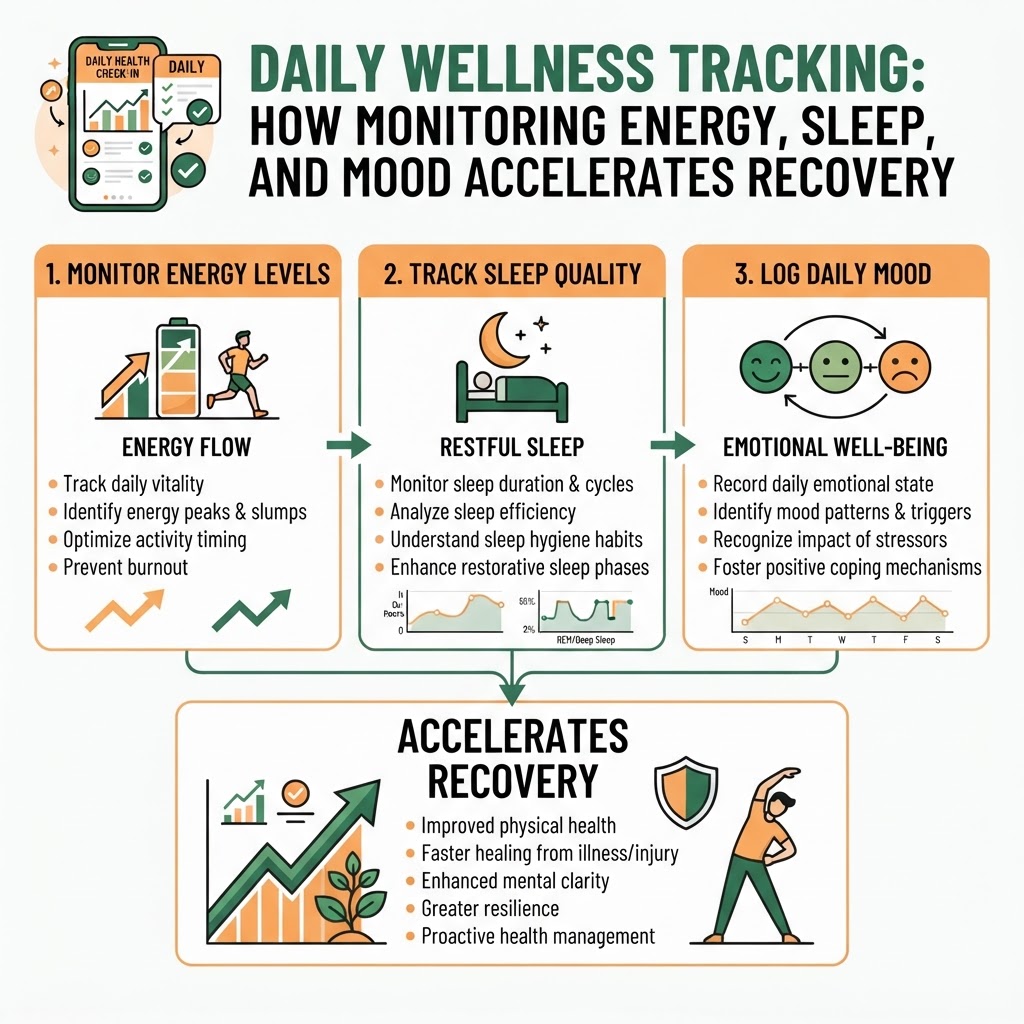
Not all wellness metrics are created equal. While it can be tempting to track everything from heart rate variability to hydration levels, three core indicators form the backbone of meaningful daily health check-ins.
1. Energy Levels
Energy is your body's most immediate communication system. It reflects mitochondrial function, inflammatory load, nutritional status, and nervous system regulation — all at once.
A simple daily energy rating (on a scale of 1–10, logged at the same time each morning) can reveal:
- Patterns of depletion — consecutive low-energy mornings often precede immune challenges or overtraining
- Nutritional gaps — especially relevant for those on calorie-restricted or post-surgical diets
- Gut health signals — poor nutrient absorption, often linked to microbiome disruption, consistently shows up as chronic low energy before other symptoms appear
During a probiotic wellness journey, for instance, improvements in gut flora diversity correlate with measurable increases in reported energy — often within 2–3 weeks of consistent probiotic use.
2. Sleep Quality
We now have robust evidence that sleep is not passive rest — it is active biological repair. The National Institutes of Health identifies sleep as essential for immune function, tissue repair, hormonal regulation, and cognitive performance.
Yet most recovery protocols completely undervalue it as a tracking variable.
When you log sleep quality daily — including time to fall asleep, number of wake-ups, and how refreshed you feel on rising — you start to identify the inputs that disturb or enhance it. Common culprits include:
- Late-evening screen exposure
- High-fat meals within 2 hours of bedtime
- Antibiotic use disrupting the gut-brain axis
- Stress hormones spiking from under-recovery
Energy, sleep, and mood tracking together create a feedback triangle: poor sleep degrades mood; poor mood spikes cortisol; elevated cortisol suppresses energy and disrupts sleep. Once you see this cycle in data, you can intervene at any point.
3. Mood and Cognitive Clarity
Mood is perhaps the most underappreciated biomarker in recovery science. It is not a "soft" metric — it is a direct readout of neuroendocrine function, inflammation levels, and gut-brain axis signalling.
A landmark study in Nature Microbiology demonstrated the profound connection between gut microbiome composition and mood regulation, reinforcing what clinicians have long observed: patients with healthier gut microbiomes report more stable mood, lower anxiety, and faster cognitive recovery post-surgery or illness.
Tracking mood with a simple 3-point daily check-in (low, neutral, elevated) requires less than 30 seconds. But over 30 days, it builds a map of your psychological resilience — one that your doctor, nutritionist, or recovery team can actually use.
How a Recovery Tracking App Transforms Raw Data Into Action
Journaling works. But apps work better — especially when they're purpose-built for recovery contexts.
Our Recovery App was designed specifically for post-surgical and recovery patients who need a structured, low-friction way to complete their daily health check-in. It takes under two minutes, captures energy, sleep, mood, bowel health, and physical activity, and — crucially — displays your trends visually over time.
Here's why this matters clinically:
1. Pattern Recognition A single bad day is noise. A five-day downward trend in energy following antibiotic use is a signal. The recovery tracking app distinguishes between the two, flagging when any metric drops below your personal baseline for three or more consecutive days.
2. Accountability and Motivation Behavioural psychology consistently shows that tracking increases adherence. When you can see your sleep improving from a 4/10 average to a 7/10 over six weeks, you protect the habits that made it happen.
3. Communication With Healthcare Providers One of the most frustrating aspects of medical appointments is the question: "How have you been feeling?" Most patients shrug and say "okay, I think." With logged data, you can answer precisely — and that precision leads to better clinical decisions.
4. Integration With Nutritional Interventions Many users pair the app with structured supplements like BioGain™, logging how their energy and gut symptoms change after meals. This turns supplementation from guesswork into measurable science.
The Gut-Brain Connection: Why Probiotics Belong in Your Tracking Routine
No discussion of recovery tracking would be complete without addressing what's happening inside — specifically, in the 100 trillion microorganisms that make up your gut microbiome.
Post-surgical dysbiosis (disruption of gut bacteria) is one of the most underdiagnosed contributors to slow recovery. Antibiotics, anaesthesia, stress hormones, and altered diets all deplete beneficial bacteria — and the downstream effects show up precisely in the three metrics we track: energy, sleep, and mood.
This is where BioGain™ plays a supporting role in the recovery picture. Using Velobiotics™ microencapsulation technology, BioGain™ delivers 1000x more live probiotics to the gut compared to conventional probiotic supplements — where most bacteria are destroyed by stomach acid before they ever reach the intestine.
For patients on a structured probiotic wellness journey, this difference is measurable. Users tracking daily with the recovery app often begin to see upward trends in energy and mood within the second or third week of consistent use — not because BioGain™ is a magic fix, but because restoring microbial diversity removes a key obstacle to recovery.
You can explore the science behind Velobiotics™ microencapsulation in detail on our science page.
Practical Tips: Building a Daily Wellness Tracking Habit That Sticks
The biggest barrier to wellness monitoring isn't motivation — it's friction. Here are seven evidence-informed strategies to make daily tracking a non-negotiable part of your recovery routine:
Set a Fixed Anchor Time
Tie your check-in to an existing habit: morning coffee, brushing your teeth, or taking your supplements. Habit stacking reduces cognitive load and dramatically improves consistency.
Keep It Minimal (But Meaningful)
You don't need to log 20 variables. For most people, five metrics — energy, sleep quality, mood, appetite, and one symptom specific to their recovery — is more than sufficient and takes under 90 seconds.
Use Visual Summaries Weekly
Don't just log — review. Every Sunday, spend five minutes looking at your weekly trends. Ask: What went well? What tanked? What changed?
Log Interventions, Not Just Outcomes
Note when you start a new supplement, change your diet, or have a stressful event. This context transforms data from a diary into a cause-and-effect map.
Involve Your Care Team
Share your weekly summary with your GP, physiotherapist, or dietitian. Many clinicians are now using patient-reported outcome apps to inform treatment decisions — and even your bulk-up plan can be refined based on your logged energy and gut health patterns.
Don't Let Perfect Be the Enemy of Good
Missed a day? That's fine. Two missed days? Still fine. What you're building is a trend line, not a perfect record. Restart without guilt.
Celebrate Small Wins
Did your sleep score improve three days in a row? Note it. Did you hit 7/10 energy for the first time in a week? Mark it. Recovery is incremental — your tracking system should honour that.
Post-Surgery Wellness: A Special Case for Structured Monitoring
For patients recovering from surgery, the stakes of poor wellness monitoring are particularly high. Post-operative complications — including infection, delayed wound healing, and prolonged fatigue — are often preceded by subtle shifts in energy and sleep that go unnoticed without a structured check-in system.
A 2021 review published in JAMA Surgery found that remote monitoring of patient-reported outcomes in the first 30 days post-surgery was associated with a 27% reduction in emergency readmissions. Patients who logged symptoms daily and had those symptoms reviewed by their care team were significantly more likely to catch complications early — before they escalated.
Post-surgery wellness tracking doesn't require expensive wearables or complex protocols. It requires:
- A simple daily health check-in system
- Clear thresholds for when to escalate to your care team
- Consistent documentation of gut health, wound site comfort, sleep, energy, and mood
Our recovery tracking app was built with exactly this population in mind. It includes guided post-surgical check-ins calibrated to different recovery windows (Days 1–7, Days 8–30, Days 30–90), so your monitoring adapts as your recovery evolves.
The Long Game: Turning Short-Term Recovery Into Lifelong Wellness Awareness
Here's what 15 years of clinical practice has taught me: the patients who recover fastest aren't necessarily the ones with the best genetics, the most resources, or the most aggressive treatment plans. They're the ones who know themselves.
They know that their energy dips when they skip breakfast. They know that two nights of poor sleep triggers an IBS flare. They know that their mood drops before their energy does — and that mood drop is the earliest warning signal they have.
This self-knowledge doesn't come from a single blood panel or a yearly check-up. It comes from daily wellness monitoring, sustained over weeks and months, until the patterns become as recognisable as your own handwriting.
Whether you're navigating post-surgery wellness, rebuilding your gut after a course of antibiotics, supporting muscle recovery with a structured plan like the bulk-up plan, or simply trying to feel more consistently energised and clear-headed — tracking is the foundation everything else is built on.
Conclusion: Your Recovery Starts With Paying Attention
The gap between a slow, frustrating recovery and a confident, progressive one often comes down to one thing: information. Specifically, the kind of granular, personalised, daily information that only you can generate about your own body.
Energy, sleep, and mood tracking isn't a luxury or a biohacker's hobby. It's a clinical best practice — one that empowers patients, supports healthcare providers, and systematically removes the guesswork from recovery.
Combine that tracking with targeted nutritional support — like the microbiome-restoring formulation in BioGain™, powered by Velobiotics™ technology — and you have a genuinely powerful recovery toolkit: one grounded in science, personalised to your data, and built for the long game.
Ready to Start Your Recovery Journey?
Take the first step today:
👉 Download our free Recovery App and complete your first daily health check-in in under two minutes.
👉 Explore how BioGain™ supports your probiotic wellness journey with industry-leading microencapsulation technology.
👉 Dive deeper into the science behind Velobiotics™ on our science hub.
Your body is already sending you signals every single day. It's time to start listening — and logging.
Dr. Chomba Chuma, MD, is the founder of BioGain™ and Velobiotics™. His clinical work focuses on gut health optimisation, post-surgical recovery, and the intersection of nutritional science and personalised wellness.
Get gut-smart, one email at a time
Science made simple, practical tips and member-only offers from BioGain. No spam, unsubscribe anytime.
By subscribing you agree to receive emails from BioGain (Velobiotics). Unsubscribe in one click.
Dr. Chomba Chuma, MD & Founder
Dr. Chomba Chuma is a medical doctor and the founder of Velobiotics™ and BioGain™. With a passion for gut health, recovery medicine and evidence-based nutrition, he created BioGain™ to bring clinically effective probiotic science to people who need it most — those healing, rebuilding, and performing at their peak.
Ready to Start Your Journey?
BioGain™ delivers 1000x more live probiotics to your gut with Velobiotics™ microencapsulation technology.